
Cause of Koolen-de Vries syndrome
KdVS is a hereditary condition.
What does heredity mean?
Our body contains hereditary information. This information tells our body how to grow and work. We receive this information from our parents.
Every child receives:
- half of the hereditary information from the mother
- the other half from the father
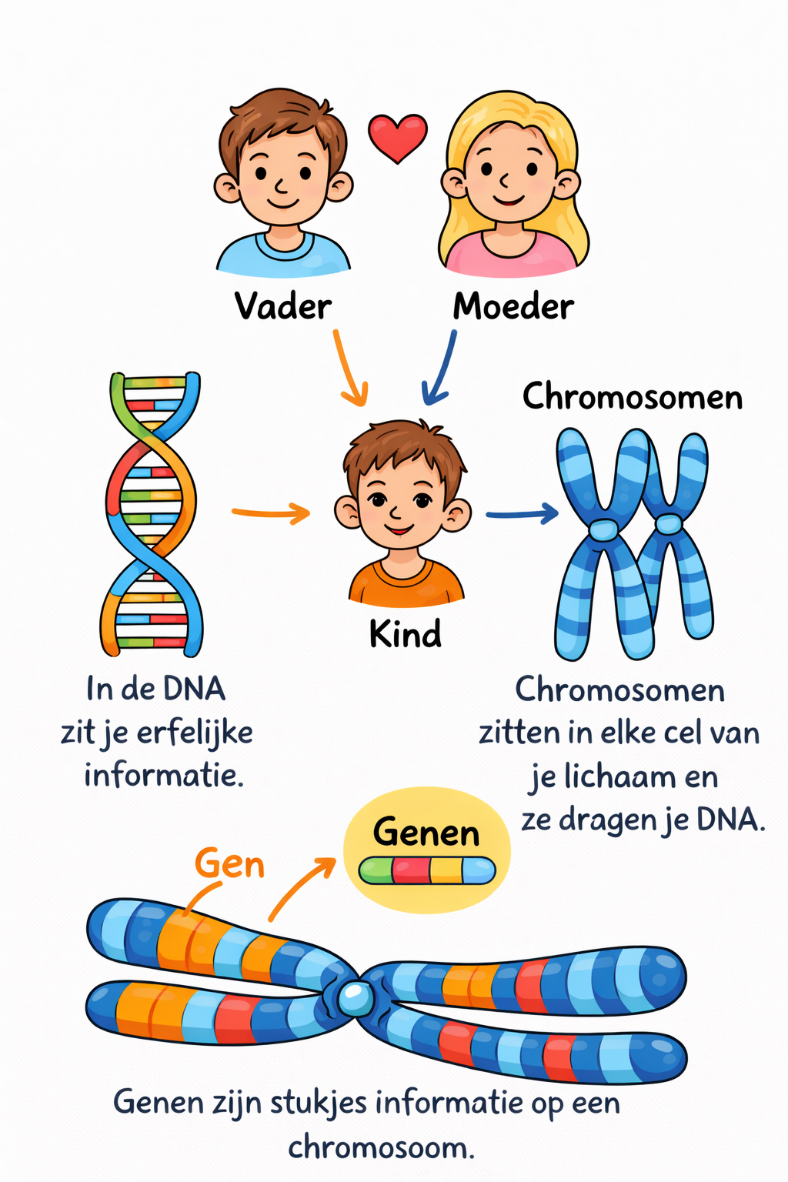
Usually Koolen-de Vries syndrome arises by chance. Parents have done nothing wrong. In most cases the parents do not have the syndrome themselves.
Your body is made up of cells. In almost every cell of your body there are chromosomes. Chromosomes are a kind of threads. They consist of a substance we call DNA. This contains a code for all our hereditary characteristics.
Genes are located on chromosomes. A gene is a small piece of DNA.
Genes determine your characteristics, for example:
- what you look like (such as your eye colour or hair colour)
- how your body works
- how the body grows
- how the brain works
- how someone develops
Cause of Koolen-de-Vries syndrome
In KdVS, a small piece of chromosome 17 (17q21.31) is missing or a piece has changed. This piece contains an important gene: the KANSL1 gene.
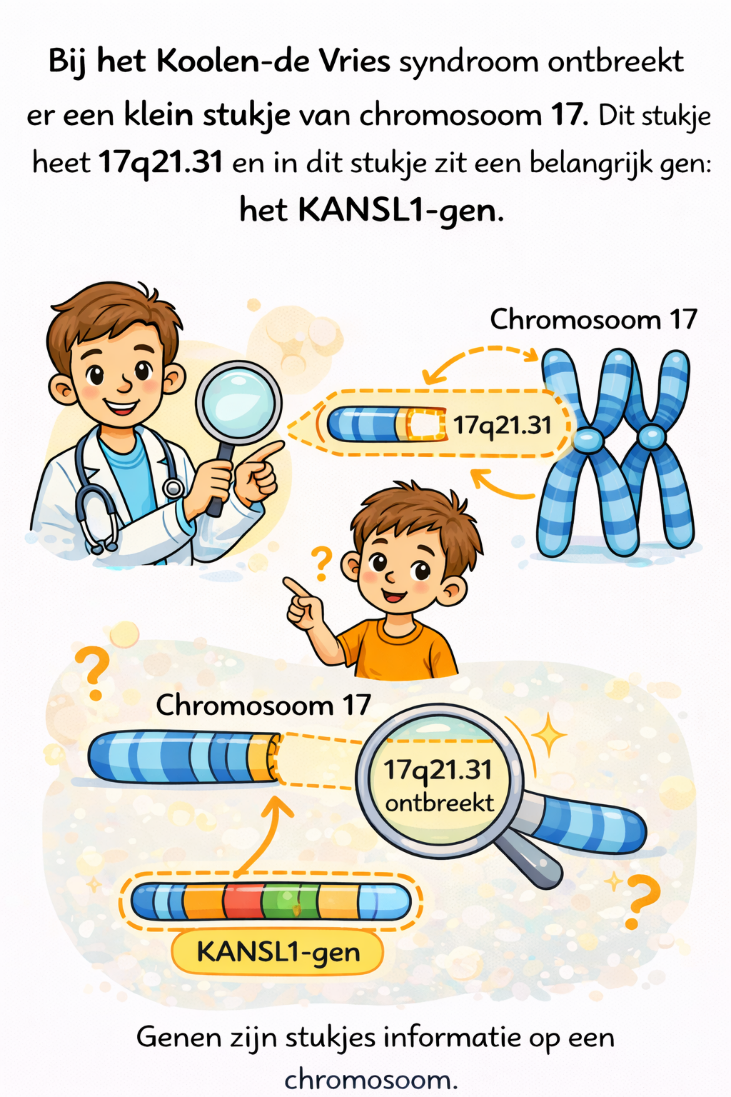
As a result, the body does not receive all the information it needs. This can influence the child’s development and health.
These changes in the hereditary material can cause delayed development, learning difficulties and sometimes other health problems. Not everyone with this syndrome has the same symptoms. The severity and type of problems can differ from person to person.
What is the KANSL1 gene?
The KANSL1 gene lies on a specific part of chromosome 17. Chromosomes are located in the nucleus of our body cells. They contain hereditary information. This information determines how our body grows and how it works.
People have 23 pairs of chromosomes. Of each pair, one comes from the mother and one from the father. The chromosomes are numbered from 1 to 22. The 23rd pair are the sex chromosomes. Women have XX and men have XY.
Each chromosome has a short part (p) and a long part (q). The KANSL1 gene lies on the long part of chromosome 17. This location is called 17q21.31.
Until 2012, Koolen-de Vries syndrome was also called the 17q21.31 microdeletion syndrome.
Important to know
- This syndrome is rare.
- Parents cannot do anything about it.
- Every child with this syndrome is unique
- Research into this syndrome is still ongoing.
Doctors and researchers are learning more and more. As a result, they can help children with KdVS better in the future.
Research into the syndrome
The information we now have about this syndrome comes from research in a small group of people. A lot of research is still being done. The help of parents and caregivers is very important in this. Researchers collect and review medical data from people with this syndrome. Through this research, doctors can give better advice in the future about care, treatment and health monitoring.